HISTORY OF THE CORNISH PASTY
The Cornish pasty is a regional dish from the far Southwestern peninsula of the British Isles. It is well known and much enjoyed throughout Britain.
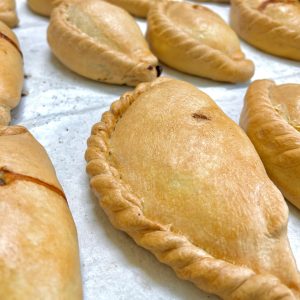
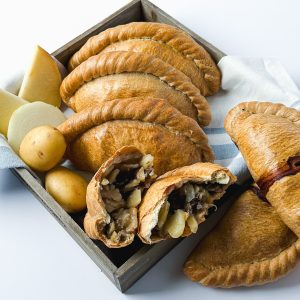
It was probably the first complete take-away meal originally designed for the Cornish miner and farmer who was away working all day and needed a meal but had no facilities to prepare one. The reason the filling was contained in a pastry case with a thick crust along one side was to hold on to, especially as their hands were dirty or tainted with tin, copper or iron. Often in previous times this was discarded or fed to "The Cornish Knockers" (ghosts of dead colleagues said to haunt the mines). The traditional filling was meat or fish, potato, onion, turnip and a little butter or cream.
The housewife prepared these daily for the man of the house and for the children who took them to work or school. It was the staple diet of the Cornish for many years. As the mines in Cornwall declined and "Cousin Jack" travelled extensively to find work this recipe went with him and still today one can still find small outcrops of societies all over the world producing the Cornish pasty, especially in Australia, South Africa, Canada and America.
There are many discussions as to the best pasty, the position of the crimp, what type of pastry to use the content etc. Nowadays the younger generation still love their pasty but with the demands of modern day life fewer people are making them.
The commercially produced pasty in the UK is a growing business within the peninsular with thousands made every day: unfortunately the standard can vary enormously and a lot of these products have given the County's national dish a bad name. You can get a commercially produced pasty in all shapes, sizes and flavours some bearing little resemblance to the original article.
I believe that in England the general public are turning their backs on mass produced tasteless fare and are again looking for good wholesome food and regional fare is at the top of the list.
With the advent of time the variety of fillings has moved away from the original recipe to cater to the demands of the general public and to a certain extent reflecting the regional and ethnic influences on our society over the years. Despite these factors plus the problems experienced with British beef over the years we still find that the traditional steak pasty still far outsells any other flavour.
At the Chough Bakery we have won many prestigious prizes including the Golden pasty award by Mr William Grimes, the New York food critic, aimed at finding the best pasty in the Southwest. We were also awarded a silver medal by “The Taste of the West” in 2007 and then achieved first prize in the 2008 Western Bakery Championships.
The team have worked long and hard to develop a recipe and production method that is adaptable to all size of operation; using equipment that is readily available in most bakers’ kitchens.
We are constantly asked why our pasty is so good, why they taste differently to any others. There is no real secret, we believe that there is only one way to produce a good pasty and that is on site. Any commercial pasty has to have chemical additives, be frozen transported defrosted etc no matter how good the product is at the start, at the end of this process it will taste inferior. This is a route we do not want to take. We want people to taste the real thing not cheap mass produced imitations. The answer lies in returning to the original concept and production methods. Always use the best quality ingredients available, remember you are producing a premium product. Always prepare on site using the best quality meat and a good strong pastry to hold it together.
You can make a pasty at home, just follow the recipe and ask if you need help. If when you are next in Padstow and are experiencing problems I can always fix up a quick lesson for you,
Happy baking ELAINE
|